



Best SEO-Friendly CMS in 2026: Ranked and Compared
by CueForGood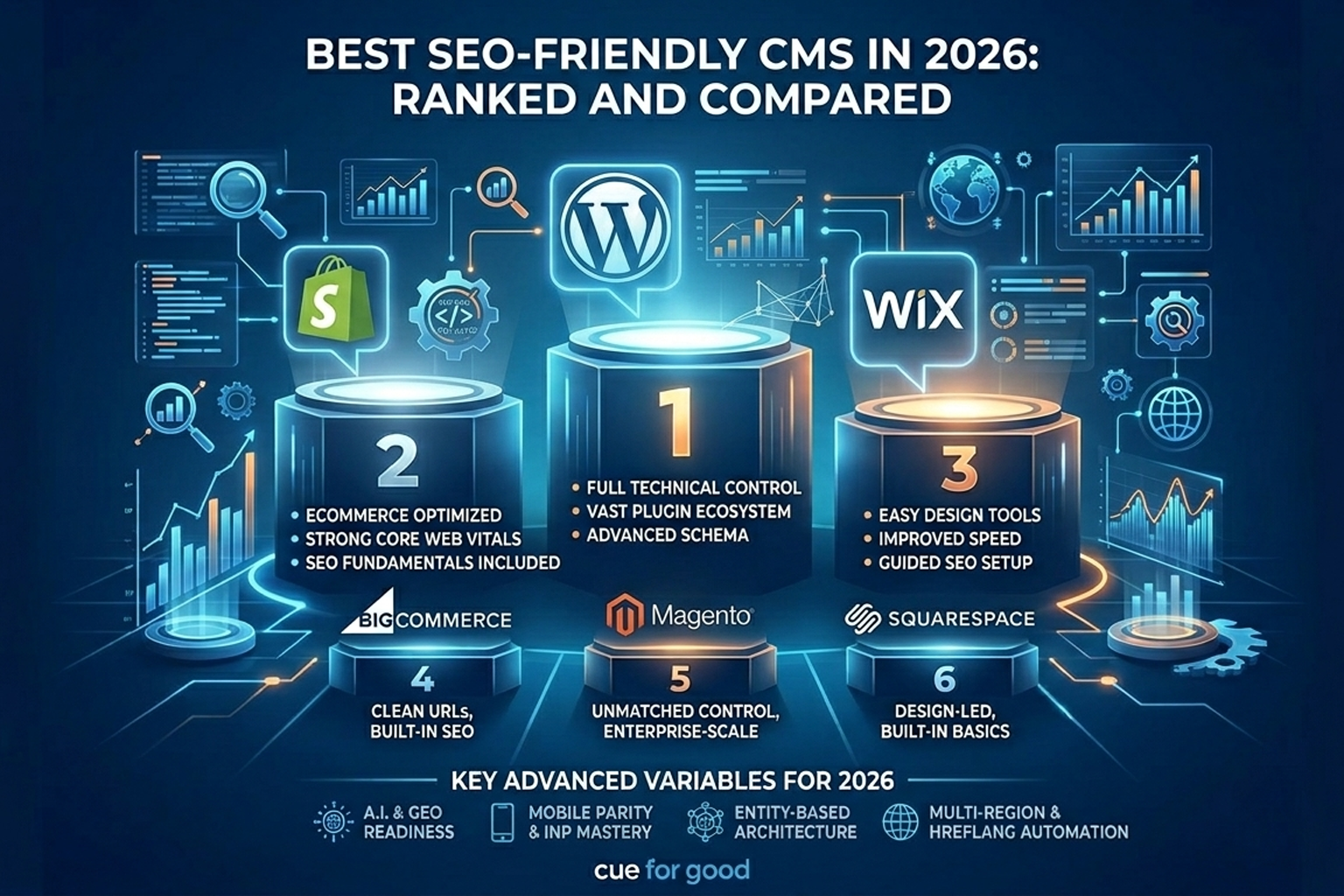
Your CMS choice is one of the most consequential SEO decisions you will make. An analysis of 59,033 top-ranking domains by Rankability confirms what we see with clients regularly: platform architecture creates a ceiling on what SEO performance is achievable, regardless of how good your content is. Some platforms hand you full control over every technical SEO variable. Others bake in limitations that no amount of optimisation will undo.
This guide cuts through the noise on six of the most widely used platforms, split into two categories: content-heavy websites and eCommerce stores. For each one, we look at what it does well on SEO, where it falls short, and who it actually makes sense for.
What is an SEO-friendly CMS?
An SEO-friendly CMS is a content management system that gives you meaningful control over the technical and on-page elements that influence search rankings. That includes custom URL structures, editable title tags and meta descriptions, XML sitemap generation, canonical tags, redirect management, and schema markup support.
A CMS can be visually polished and functionally solid while still being a liability for SEO. What matters is the degree of control it gives you, and how much of that control requires a developer to exercise.
Does your CMS actually affect SEO?
Yes, and more than most business owners assume. The CMS determines how cleanly your pages render, how much control you have over your URL structure, how fast your pages load, and whether search engines can crawl your content without running into platform-generated obstacles.
Google’s Core Web Vitals have added another layer to this. Platforms that ship with bloated JavaScript, render content client-side, or generate duplicate URLs at the framework level put sites at a structural disadvantage from day one. Data from the 2025 Core Web Vitals CMS Challenge published by Search Engine Journal shows WordPress passing at 43.44% versus Shopify’s 75.22%. That gap is almost entirely explained by hosting and theme quality on WordPress, not the CMS itself. The point is that the platform sets a floor, and some floors are lower than others.
What SEO features should a CMS have?
A capable CMS should give you direct control over the following:
URL structure: full control over slugs, no auto-generated query parameters or forced subdirectories
Title tags and meta descriptions: editable at the individual page level, not templated globally
XML sitemaps: auto-generated and updated as content is added or removed
Canonical tags: configurable to prevent duplicate content from confusing search engines
Redirect management: 301 redirects without requiring a developer or third-party plugin
Schema markup: either built-in or easily implemented via plugin or code injection
Core Web Vitals: page rendering and theme architecture that supports strong LCP, CLS, and FID scores
Image optimisation: WebP support, lazy loading, and compression without manual intervention
Mobile performance: responsive by default, not as an afterthought
If a platform requires a workaround, a paid plugin, or a developer to tick any of the boxes above, treat that as a real cost in your evaluation, not a minor inconvenience.
Best CMS for SEO: Content-Heavy Sites
WordPress
WordPress is the most SEO-capable content CMS available. It powers around 43% of all websites and holds a disproportionate share of top Google rankings across competitive content verticals. The reason is the plugin ecosystem: Yoast SEO and Rank Math give non-technical users access to professional-grade SEO tooling without writing a line of code. Title tags, meta descriptions, canonicals, schema markup, XML sitemaps, and redirect management are all handled through these plugins with a clean, guided interface.
WordPress gives you full control over URL structures, heading hierarchies, and internal link architecture. Core Web Vitals performance is highly variable: an unoptimised WordPress site with a heavyweight theme can post dreadful scores. A site running on a modern host like Kinsta or WP Engine with a lightweight theme such as GeneratePress or Kadence will consistently outperform most competing platforms on technical SEO benchmarks.
The tradeoff is maintenance overhead. WordPress requires plugin updates, security patches, and periodic performance auditing. For a business owner without technical support, that burden is real and should factor into the decision.
Best for: Content-led brands, B2B companies with large editorial output, publishers, and any site competing in high-volume informational search.
Wix
Wix has earned back significant credibility on SEO since its early reputation as a search engine dead zone. Its Core Web Vitals passing rate jumped from 49.3% in early 2023 to 58.7% in 2024, according to independent benchmark data. Automatic XML sitemaps, editable meta tags, built-in schema markup, and a guided SEO setup checklist make it genuinely functional for most small business use cases.
The ceiling is real. Wix’s proprietary architecture limits server-level configuration: you cannot control caching policies, resource loading order, or server logs. URL structures are more constrained than WordPress, and the reliance on heavy JavaScript remains a limiting factor for page speed on complex pages. For sites competing in technically demanding niches or publishing at scale, those constraints will eventually show up in rankings.
Best for: Small businesses, local service providers, and sites where design and ease of management matter more than deep technical SEO control.
Squarespace
Squarespace produces clean, fast-loading pages from its built-in templates and covers the on-page SEO basics. Title tags, meta descriptions, image alt text, and XML sitemaps are all handled. In March 2025, Squarespace added AI-assisted SEO tools that suggest page titles, meta descriptions, and alt text automatically, reducing the manual workload for non-technical users.
Where it falls short is image compression and custom schema. Independent tests consistently find it difficult to compress Squarespace images below 100kb, which affects page speed in ways the platform cannot fully compensate for. Category page metadata is not directly editable, a meaningful limitation for sites with significant content depth or product categories. There is no plugin ecosystem, so you work within what Squarespace ships, nothing more.
Best for: Portfolio sites, design-led brands, and low-volume content sites where aesthetics are the priority and SEO competition is low.
Best CMS for SEO: eCommerce
Shopify
Shopify is the dominant eCommerce CMS and performs well on the fundamentals out of the box. Its Core Web Vitals passing rate sits at 75.22% across the platform, with average page load times around 1.3 seconds on modern themes. Title tags, meta descriptions, alt text, and XML sitemaps are built in and manageable without developer involvement.
The known limitation is the URL structure. Shopify forces ‘/products/’ and ‘/collections/’ into all product and category URLs, and you cannot remove them. Products accessible through multiple collections also generate duplicate URLs, which dilutes link equity. Shopify mitigates this automatically with canonical tags, and for most stores, the practical SEO impact is manageable. Apps like Yoast for Shopify and SEO Manager extend the platform’s capabilities where native tooling stops.
Best for: DTC brands, sustainable eCommerce businesses, and mid-market retailers who want a strong SEO baseline without developer dependency.
Magento (Adobe Commerce)
Magento gives you more technical SEO control than any other e-commerce platform. URL structures are fully configurable. Meta tags, canonical tags, hreflang for international stores, robots.txt, schema markup, and every on-page element are accessible and adjustable at the code level. Unlike BigCommerce, Magento supports a native content blog, which matters for brands that want to compete on informational content alongside product pages.
The cost is significant. Magento requires experienced developers to configure correctly, and its SEO advantage is only realised when someone with the right skills is actually using it. A poorly implemented Magento site will underperform a well-configured Shopify store. For large retailers with a technical team, Magento is the most capable option available. For everyone else, it is overkill.
Best for: Enterprise retailers, large product catalogs exceeding 10,000 SKUs, and businesses with in-house or agency development resource.
BigCommerce
BigCommerce sits between Shopify and Magento in both control and complexity. URL structures are cleaner than Shopify by default, with no forced subdirectory constraints. Built-in features include schema markup and rich snippets on product pages, automatic sitemaps, configurable canonical tags, and SSL without additional setup. The Stencil framework produces fast-loading storefronts, and Core Web Vitals scores are competitive without significant theme customisation.
BigCommerce has a smaller app ecosystem than Shopify, but its built-in SEO tooling reduces the dependence on third-party apps to cover gaps. It is the strongest mid-market option for retailers who have run into Shopify’s URL structure or schema limitations but are not ready to take on Magento’s complexity and cost.
Best for: Mid-market eCommerce, product-heavy stores, and retailers scaling beyond Shopify’s built-in constraints.
How to choose the best CMS for SEO
Start with business type, not feature lists. Content-led businesses and eCommerce businesses have different SEO requirements, and the best platform for one is rarely the best for the other.
For content-heavy sites, the core question is how much technical control you need and how much maintenance you can sustain. WordPress is the clear answer if you have the resources to manage it properly. If you are running a lean operation without technical support, Wix covers the fundamentals adequately for most local or low-competition scenarios. Squarespace is worth considering only if design is the primary concern and SEO competition in your niche is low.
For eCommerce, the question is scale and available technical resource. Shopify is the right starting point for most sustainable and purpose-driven brands. BigCommerce becomes worth evaluating once you start running into Shopify’s URL structure or schema limitations. Magento only makes sense with a development team behind it, and even then, the implementation cost needs to justify the SEO ceiling it unlocks.
One factor that applies across all six platforms: test page speed before committing. Run your shortlisted options through Google PageSpeed Insights on real store or blog examples. Platform claims about performance are marketing. Actual PSI scores are data.
Final verdict
No CMS is universally best for SEO. The right choice depends on what you are building, your technical resources, and how aggressively you plan to compete in organic search.
For content-heavy sites, WordPress remains the benchmark. For eCommerce, Shopify is the practical starting point for most brands. BigCommerce is the strongest alternative for businesses that need cleaner URL control and built-in schema without going enterprise. Magento is the ceiling on technical SEO capability, but it only makes sense with the team to sustain it.
If you are a sustainable or purpose-driven brand evaluating your platform options and want a direct recommendation based on your specific situation, get in touch with the CueForGood team at: letstalk@cueforgood.com.
- About the Author
- Latest Posts


One Reply to “Best SEO-Friendly CMS in 2026: Ranked and Compared”
Comments are closed.
-
Google Ads copy with AI: fix the ad group first, then check the combinations
by Kunal Mahajan
Better ads start with the right searches and the facts on your product page. Say you run an online cycling …
Continue reading “Google Ads copy with AI: fix the ad group first, then check the combinations”
-
Google Shopping for Ecommerce: A Simple Guide to Getting More Sales
by Yash Pal
Google Shopping has changed a lot over the years. The way Google Shopping campaigns work today is very different from …
Continue reading “Google Shopping for Ecommerce: A Simple Guide to Getting More Sales”
-
How to audit what AI is saying about your brand in 30 minutes
by Rajiv Singha
AI visitors convert at 4.4x the rate of traditional organic traffic. And AI search traffic is up 527% year on …
Continue reading “How to audit what AI is saying about your brand in 30 minutes”
-
Sustainable vs Green Marketing: Key Differences and When to Use Each
by Tapam Jaswal
You’ll see the terms “green marketing” and “sustainable marketing” used interchangeably online. They are not the same. Here’s a side-by-side …
Continue reading “Sustainable vs Green Marketing: Key Differences and When to Use Each”
-
Why Feed-Only PMax Campaigns Are the Smartest Choice for Ecommerce stores
by Yash Pal
If you sell products online, you have probably heard about Google’s Performance Max (PMax) campaigns. They have been a hot …
Continue reading “Why Feed-Only PMax Campaigns Are the Smartest Choice for Ecommerce stores”
-
Email Marketing Without Fatiguing Conscious Consumers
by Charanjeev Singh
How to build trust, reduce inbox overload, and engage with intention Email marketing is a powerful tool. It lets …
Continue reading “Email Marketing Without Fatiguing Conscious Consumers”
Many CMS products are now providing the ability to develop web sites and web applications with RSS and other Web 2.0 funtions built in. The result is that websites are now being developed as blog sites, or at least as what appears to be a blog site.
In my opinion this is the biggest trend in website design. In the near future, new websites designed with the latest CMS’ will have the same personality and functionality of blog sites.
I think this is great because it is part of the evolution to Web 2.0 for the masses, not just for the early adopters who blog and have profiles in social networking sites.
Since Web 2.0 site have so many cross links, they will be search engine friendly by design.
But, as you point out being search engine friendly doesn’t necessarily mean having high rankings for desirable keywords. That still takes strategy and work to achieve.